
Wooden Bollards vs Metal Bollards: Which Option Is Right for Your Site?
Choosing between wooden bollards and metal bollards is ultimately about balancing security, appearance, lifespan, and context. Both options perform the same core function – controlling access and protecting assets – but they behave very differently once installed.
Understanding those differences early helps avoid costly changes later and ensures the finished scheme works both practically and visually.
For specifiers, contractors, and facilities managers, the decision rarely comes down to price alone. This guide breaks down eight key considerations to help you decide which bollard material is right for your site:
- Visual impact and surrounding environment
- Security requirements and impact resistance
- Durability and expected lifespan
- Ongoing maintenance needs
- Environmental and sustainability factors
- Installation method and ground conditions
- Upfront cost versus long-term value
- Planning constraints, compliance, and access control needs
1. Visual Impact and Surroundings
Appearance is often the first differentiator between timber and metal solutions. Bollards are highly visible street features, so material choice directly affects how a space feels.
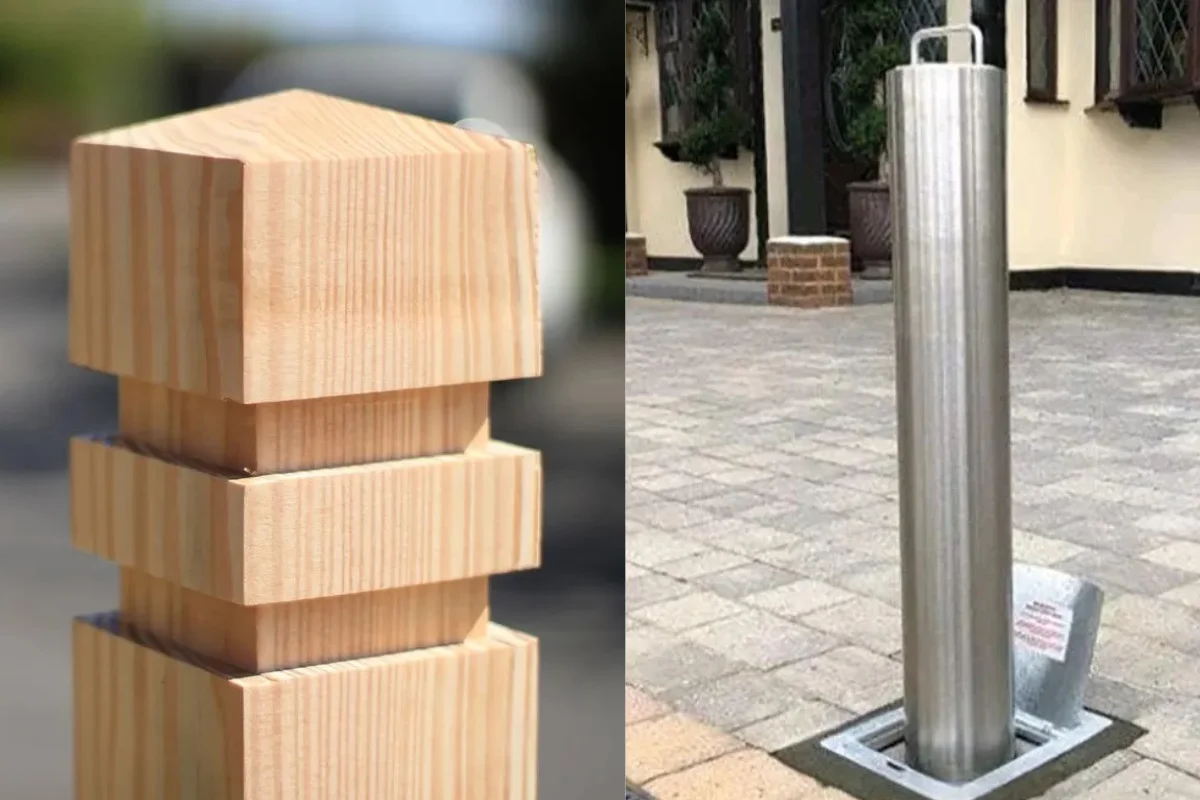
Wooden bollards create a softer, more organic presence. Natural grain, muted tones, and traditional profiles allow them to blend into parks, rural settings, heritage locations, and landscaped areas. Where planners or conservation officers want street furniture to feel understated, timber usually fits expectations more easily.
Metal bollards deliver a cleaner, more contemporary aesthetic. In particular, powder-coated steel, stainless steel, or galvanised finishes suit commercial environments like transport hubs or car parks.
Typical visual considerations include:
- Surrounding materials: stone, brick, planting, or concrete.
- Planning sensitivity: conservation status or listed settings.
- Desired presence: discreet boundary marking or assertive control.
Context matters more than preference. A visually discreet solution in a countryside car park may look out of place outside an office complex, just as an industrial steel post can feel intrusive beside a village green.
2. Security and Impact Resistance
Security requirements quickly narrow the choice. Wooden bollards provide light to moderate protection, primarily acting as visual deterrents and physical markers. They discourage parking, define boundaries, and guide vehicles, but they are not designed to withstand deliberate impact.
Metal bollards, by contrast, offer far greater resistance. Steel cores, reinforced ground fixings, and engineered anti-ram designs can stop or slow vehicles, making them suitable for pedestrian safety in higher-risk environments.
From a technical perspective, impact performance is influenced by:
- Core construction: solid timber versus hollow or reinforced steel.
- Fixing depth: shallow set or deep root-fixed installations.
- Foundation type: concrete mass and ground bearing capacity.
- Vehicle speed assumptions: low-speed control or hostile mitigation.
Consider the realistic threat level of the location:
- Low-speed vehicle guidance or parking prevention: timber may suffice.
- Busy roads, vulnerable frontages, or security-sensitive sites: metal is usually the safer choice.
Over-specifying can be unnecessary, but under-specifying creates risk.
3. Durability and Lifespan
Longevity varies significantly between materials and finishes.
Wooden bollards are typically pressure-treated to resist rot, fungal growth, and insect damage. With correct installation and periodic treatment, timber can perform reliably for many years. Exposure to standing water, poor drainage, or neglected maintenance shortens lifespan considerably.
Metal bollards are generally more durable over time. Galvanised steel resists corrosion, while stainless steel performs particularly well in exposed or coastal locations. Powder-coated finishes add further protection and allow colour coordination with surrounding infrastructure.
Key durability factors to assess include:
- Exposure level: urban pollution, salt air, or standing moisture.
- Finish specification: treatment class, coating thickness, or grade.
- Installation quality: drainage provision and ground stability.
- Expected wear: vehicle contact frequency and pedestrian traffic.
From a lifecycle perspective, metal often lasts longer with less intervention, although a (typically) higher initial cost reflects that durability.
4. Maintenance Requirements
Bollard maintenance should never be an afterthought. It directly affects whole-life cost.
Wooden bollards require inspection and occasional re-treatment to maintain appearance and structural integrity. Surface weathering is natural, but untreated damage can accelerate decay. Maintenance schedules should be realistic and budgeted from the outset.
Metal bollards are largely low-maintenance. Occasional cleaning and surface checks usually suffice, although chipped coatings or damaged galvanisation should be repaired promptly to prevent corrosion.
Typical maintenance considerations include:
- Inspection frequency: annual visual checks or reactive reviews.
- Surface care: re-oiling timber or washing coated steel.
- Repair approach: on-site refinishing or full replacement.
5. Environmental Considerations
Sustainability increasingly influences specification decisions.
Timber bollards made from responsibly sourced wood are renewable and biodegradable. FSC-certified timber supports sustainable forestry and typically carries a lower embodied carbon footprint than steel alternatives. For environmentally sensitive projects, this can be a decisive factor.
Metal bollards involve energy-intensive manufacturing, although long service life partially offsets that impact. Recyclability at end of life is another advantage, particularly with steel products.
Environmental assessment may include:
- Material origin: certified timber or recycled steel content. Our Seaton Timber Bollards, for instance, use responsibly-sourced Scandinavian timber.
- Manufacturing footprint: processing energy and transport distance.
- Service life: replacement cycles and waste generation.
- End-of-life handling: biodegradation or material recovery.
Environmental priorities vary by project, but material origin and lifespan both deserve consideration.
6. Installation and Ground Conditions
Installation methods differ subtly between timber and metal bollards, yet ground conditions affect both equally.
Wooden bollards are commonly root-fixed into concrete foundations. Correct depth, drainage provision, and stable sub-bases are essential to prevent movement and premature deterioration.
Metal bollards may be root-fixed, surface-mounted, removable, or collapsible. This flexibility allows tailored access control but demands precise specification. Ground sleeves, anchor systems, and surrounding surfaces must be matched carefully to the bollard type.
Key technical installation variables include:
- Ground makeup: soil, asphalt, or reinforced concrete.
- Fixing method: permanent, demountable, or fold-down.
- Foundation sizing: load transfer and overturning resistance.
- Drainage detailing: preventing water retention at base level.
Installation quality matters as much as material choice. Poor ground preparation undermines performance regardless of construction.
7. Cost vs Long-Term Value
Upfront cost often favours timber. Wooden bollards are generally cheaper to purchase and install, making them attractive for large schemes with minimal security requirements.
Metal bollards usually cost more initially but can offer better value over time through durability and reduced maintenance. When replacement cycles, labour, and disruption are factored in, metal may prove more economical for demanding locations.
Cost evaluation should account for:
- Initial supply and installation expenditure.
- Planned maintenance over service life.
- Likely replacement intervals.
- Operational disruption during repairs.
The right calculation focuses on total ownership cost, not headline price.
8. Planning, Compliance, and Access Control
Local authority requirements, planning conditions, and access needs can influence material selection.
Heritage areas often prefer timber. Urban environments, meanwhile, may require metal to meet safety standards or vehicle mitigation expectations. Removable or collapsible bollards are typically metal by necessity, supporting flexible access for emergency or authorised vehicles.
Early-stage considerations often include:
- Planning guidance and streetscape policies.
- Equality and accessibility requirements.
- Emergency access and servicing needs.
- Alignment with wider public realm strategy.
Early consultation avoids specification conflicts later.
Key Takeaways: Making the Right Choice
There is no universal answer when comparing wooden bollards with metal bollards. The best solution depends on environment, usage, risk profile, and long-term expectations.
As a general rule:
- Choose timber where visual harmony, sustainability, and low-impact control are priorities.
- Choose metal where strength, longevity, and security carry greater weight.
View our range of security bollards, with installation services available if required.